Edition
Dramas
Ulrich Bubrowski has set editorial standards with his Critical Edition of the Complete Dramas, which presents Ernst Barlach as one of the great German-language poets of the early 20th century. The three volumes of dramas he has edited provide comprehensive insights into Barlach's dramatic oeuvre. The texts: "Der tote Tag," "Der arme Vetter," "Die echten Sedemunds," "Der Findling," "Die Sündflut," "Der blaue Boll," "Die gute Zeit," and "Der Graf von Ratzeburg" are available for the first time in a text-genetic version that refrains from distortions or deliberate extraneous interventions. Half of the material presented in this edition was previously unpublished.
Bequeathed works in individual editions
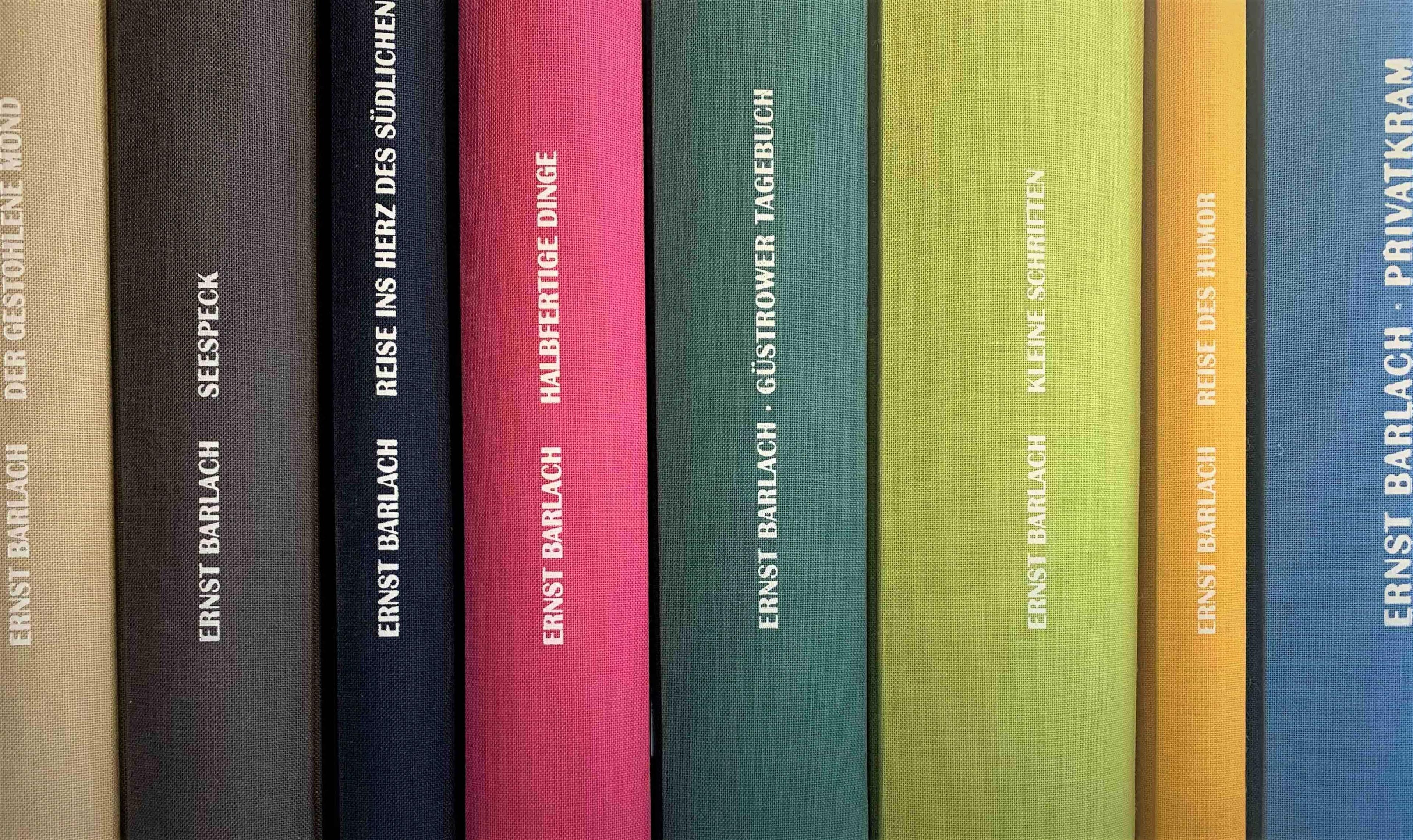
Over nearly two decades, the Ernst Barlach Society has pursued the goal of re-editing Ernst Barlach's bequeathed narrative works from the manuscripts and making them available to the public. This goal was achieved in 2019 with the publication of the final volume.
Edition scholar Ulrich Bubrowski not only edited, but also edited the individual volumes for the Ernst Barlach Society, ensuring that each volume was guided throughout by the principles of accuracy, completeness, clarity, and manageability. Our lasting gratitude therefore goes to Mr. Ulrich Bubrowski, whose fundamental work has for the first time truly secured the authenticity of Barlach's bequeathed texts and thus abolished all previous complete and individual editions of Ernst Barlach's writings.
All volumes were compiled entirely from the bequeathed manuscripts. The preservation of the authenticity of the texts was the highest priority. The criterion 'critical edition' demanded absolute respect for the tradition - down to every single letter and punctuation mark. The author's idiosyncrasy was to be brought to bear beyond today's writing and stylistic fashions. The editor has generally refrained from trimming the texts. Fragmentary material now appears as such and is not presented as something rounded off through manifold manipulations.
Each volume is accompanied by a compact material section, which offers not only the respective genesis of the work, but also further background documents and source texts that open up new perspectives. Also included is precise information on the genesis and dating of the works, on manuscript relationships, and on all editorial decisions.
The edition presents the complete prose works of Ernst Barlach, and unlike all previous editions - in each case in undistorted and unabridged form. Thus, for the first time, it also contains significant previously unpublished texts.
The individual volumes [period of origin] Characteristics
- Reise des Humor und des Beobachtungsgeistes sowie weitere Texte aus der Pariser Zeit [1895 - 1896] described by Barlach as a 'ghost novel'; satire on the art world of the time, in which the analyzing and dissecting spirit of observation and the humor surrendered to fantasy, which engages with ghosts, mummies, and skeletons, confront and question each other; [the volume was published in 2011].
- Seespeck [1913 - 1916] novel, originally titled 'The Man in the Mask'; in several episodes Seespeck, loner with sensitive organs, about whose exterior and previous life one learns almost nothing, drifts through the world and observes people; his eyes, however, seem to him like 'beggar's hands of a blind man', so he turns his gaze inward to find 'his true self'; [the volume was published 2009]
- Der gestohlene Mond [1936 - 1937] novel; the 'contemplation of a piece of life', which, however, turns out to be a barely fathomable multidimensionality of allusions and innuendos; behind the curly small-town narrow streets a second enigmatic world opens up - of almost cosmic proportions; it is about the tension between heaven and hell, spirit and matter, humanism and fascism; [the volume was published 2010]
- Reise ins Herz des südlichen Russland [1906 - 1912] travelogue, which is not about sightseeing, but about a self-discovery, to which the experience of the foreign leads and at the end of which there is a new man and another artist: 'Du darfst alles Deinige'; [the volume was published 2008]
- Güstrower Tagebuch [1914 - 1917] 'war diary', which is admittedly more than such: a worldly work that spans from scenes of small-town life in Güstrow, educational worries, food procurement problems, artist encounters in Berlin to commentary on world politics, but which is also something like a latent novel of development, revealing the first steps away from enthusiastic war affirmation toward the great memorials borne of humanistic spirit; [the volume was published in 2007].
- Ein selbsterzähltes Leben [1927] elegantly written, easy-to-read autobiography, ranging from childhood to 1906, which allows the story of self-discovery to shine through behind the experiences described; [the volume was published in 2006]
- "Privatkram" [Notes 1887 - 1938] unsystematic notes scattered over numerous manuscripts, in which Barlach appears primarily as a flesh-and-blood human being, a pragmatic and social person who makes shopping lists, records addresses and telephone numbers, but also personal and intimate things; [the volume was published in 2015]
- Kleine Schriften [1891 - 1938] 'Phantasie, Erlebtes durcheinander', a multitude of diverse mostly shorter prose texts, whose titles range from 'Hexengespräch' to 'Hegel', from 'Ehebruchsgeschichten' to 'Die Figur in der Architektur', from 'Mondscheinspuk' to 'Drama und Plastik' etc.; [the volume was published in 2013].
- Der Graf von Ratzeburg [1927 - 1936] unfinished drama, set in the Middle Ages between Orient and Occident, also evoking biblical times, showing the transformation from the secure, self-confident to the questioning and insecure, i.e. in the logic of the text: real human being; [the volume was published in 2006]
- "Halbfertigige Dinge" [projects, ideas 1892 - 1937] 'chaotic wealth': numerous mostly short, sometimes more extensive notes on diverse unfinished writing projects; [the volume appeared in 2018]
- "Reimereien" [poems, verses 1892 - 1936] occasional, nature and metropolitan, also love poems alongside reflective and playful texts; [the volume was published in 2019]